
Streamworks Blog
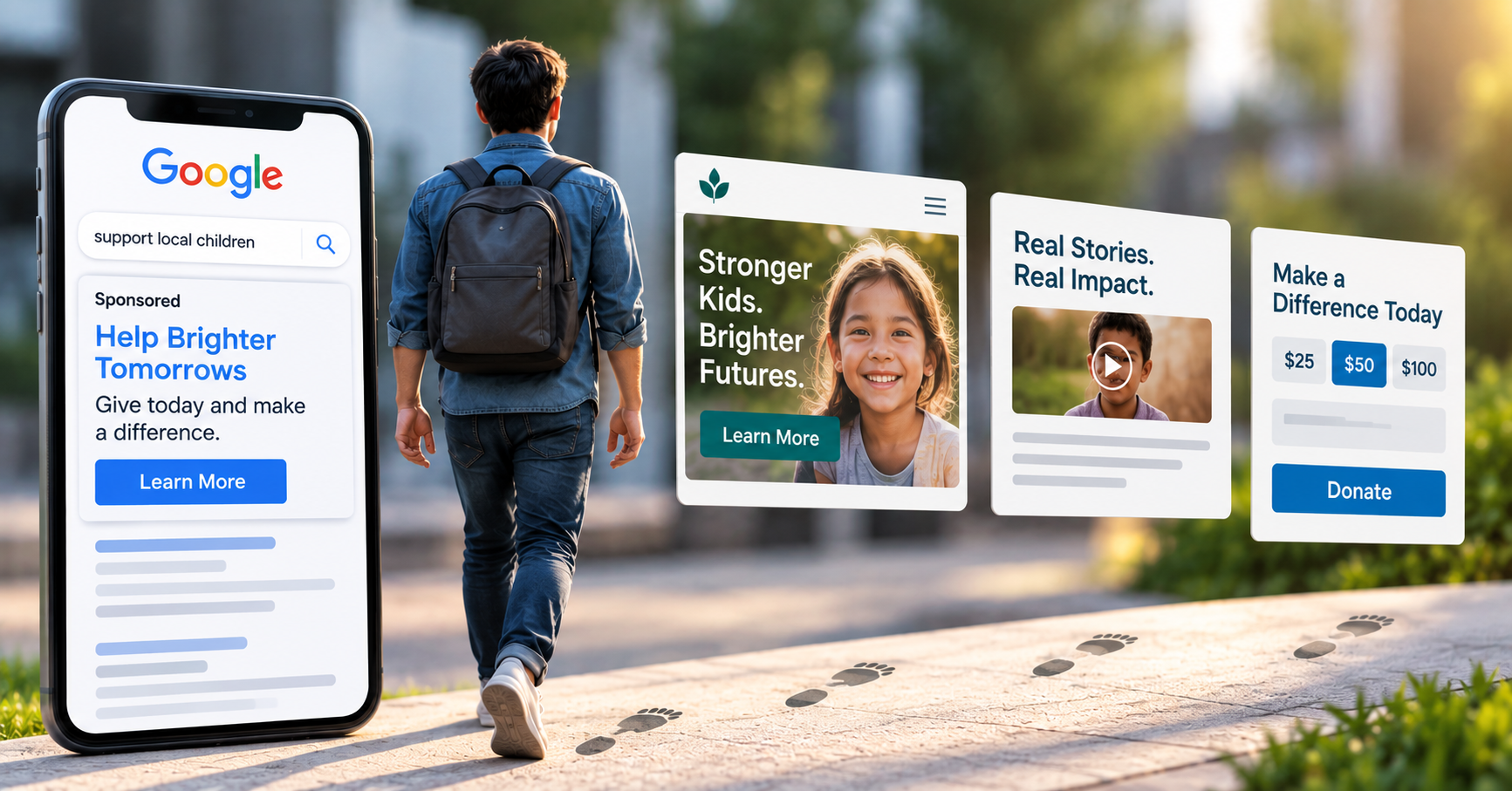
It’s a normal Tuesday.
Someone searches Google for information about cancer, animal welfare, hunger, or another cause they care about. They see a paid ad from a nonprofit they have never heard of. They click.
The landing page asks them to donate.
Are they really going to pull out their credit card and make a gift?
Maybe.
But that may be asking PPC to do too much, too soon.
Paid search can absolutely generate donations for nonprofits. The bigger question is whether the person clicking the ad already intends to give or is simply interested in the cause.
That distinction could completely change how nonprofits think about PPC as a donor acquisition strategy.
Yes, Paid Search Can Generate Donations
Let's start with the numbers.
According toM+R Benchmarks, search advertising generated $2.23 in fundraising revenue for every $1 nonprofits spent in 2024. M+R also reports that search has consistently delivered the highest return on ad spend among the digital advertising channels it measures.
The previous M+R study reported similar results. Search generated $2.70 for every $1 spent, with an average cost per donation of $55. Clearly, people do click search ads and make donations. But that does not mean every searcher is equally likely to become a donor.
What Did the Person Intend to Do Before Seeing Your Ad?
Consider two Google searches.
"Where can I donate for hurricane relief?"
and
"How can I lower my risk of cancer?"
Both people may care deeply about the issue. But they arrived at Google with very different intentions.
The first person is actively looking for somewhere to give. The nonprofit's job is relatively straightforward: demonstrate credibility, make a compelling case, and provide an easy way to donate.
The second person is looking for information. Showing that person an ad and immediately asking for money requires the ad and landing page to accomplish a lot. You have to introduce your organization, establish trust, create an emotional connection, explain your impact, create urgency, and persuade someone who wasn't planning to donate to suddenly make a financial commitment.
That's a much bigger job.
PPC ads don't always create the intent to give. Often, its greatest strength is capturing intent that already exists.
Brand Recognition May Help, But It Isn't the Whole Story
It is tempting to assume PPC fundraising works primarily for large national organizations because people already know and trust their brands. Some interesting evidence suggests larger nonprofits do have an advantage. M+R reported the following paid search results by organization size:
Large nonprofits generated $3.14 for every $1 spent, with a $43 cost per donation.
Medium nonprofits generated $3.19 for every $1 spent, with a $66 cost per donation.
Small nonprofits generated $1.40 for every $1 spent, with an $87 cost per donation.
That's a significant difference.
But we shouldn't automatically attribute it all to brand awareness. Larger organizations may have more sophisticated digital programs, better optimized landing pages, larger testing budgets, stronger creative, and more historical data.
The numbers show that simply putting a donation ad in front of people doesn't produce the same economics for every nonprofit.
Then There Is the "Normal Tuesday" Problem
Giving Tuesday is different.
Year-end is different.
A natural disaster is different.
A major news story connected to your mission is different.
Those moments can create urgency and put charitable giving on someone's mind. But what about an ordinary Tuesday in March? Someone may care about diabetes because a family member was recently diagnosed. Someone may be searching for information about adopting a pet. Someone may want to understand food insecurity in their community. Those people have demonstrated something valuable.
Interest. But interest and donation intent aren't necessarily the same thing. What if we stopped expecting PPC to turn every interested stranger directly into a donor?
What if the first conversion isn't a Donation?
This is where PPC becomes much more interesting as part of a broader donor acquisition strategy.
Instead of:
PPC → Donation
consider:
PPC → Valuable Content → Email Capture → Cultivation → Donation
Nonprofits are already investing in this approach. M+R reported that 10% of nonprofit digital advertising budgets were dedicated to lead generation, with an average advertising cost of $3.33 per lead. For an organization trying to build a future donor audience, that creates a very different way to evaluate PPC. The goal isn't necessarily to get $50 today. The goal might be to identify someone who cares about the mission and earn permission to keep the conversation going.
One Nonprofit Generated More Than 12,000 Email Subscribers From Search
The diabetes nonprofit diaTribe provides a good example. Instead of assuming someone searching for diabetes information was ready to donate, diaTribe looked at what its potential audience was searching for and created useful content around those needs.
Searchers clicked Google ads and were offered relevant downloadable resources in exchange for their email addresses. The result was 12,530 new email subscribers from Google Ad Grants. Combined with Facebook advertising, the organization added more than 45,000 subscribers in one year.
Think about the difference.
Someone didn't have to decide:
"Do I trust this organization enough to give it money?"
They only had to decide:
"Is this information useful enough that I will give them my email address?"
That's a much smaller first step. And now the nonprofit has an opportunity to build the relationship.
Another Organization Generated Donations and Leads at the Same Time
Moms in Prayer International provides another interesting example. Its Google Ads strategy wasn't measured solely by donations. The organization also tracked email subscriptions, website visits, and prayer group registrations. Over 90 days, Google Ad Grants reportedly generated $17,000 in online donations, 1,500 email subscriptions, 123 prayer group registrations, and about 60,000 website visits.
Some people were ready to give. Others were ready to engage. Both groups had value.
What Happens If You Cultivate Those Leads?
This may be the most important question. If someone isn't ready to donate today, can they become a donor later?
Vision Australia tested that idea with a two-step donor acquisition campaign. Rather than leading with a donation request, the campaign promoted a Snake Bite Safety Quiz and First Aid download. People interested in the content provided their contact information. Those prospects then entered a three-week multichannel cultivation journey before being approached about becoming regular donors.
The campaign reportedly generated more than 5,000 leads in eight weeks at $3.75 per lead. Even more interesting, 5.3% of those leads eventually converted into donors, with an average gift of $22.33. The ad didn't necessarily acquire the donor. It acquired the opportunity to create a donor. That is an important distinction.
PPC May Be the Beginning of Donor Acquisition, Not the End
This changes the strategic question nonprofits should be asking.
Instead of asking:
"Can we get donations from PPC?"
Maybe we should ask:
"What should PPC get us first?"
When someone already has high giving intent, the answer may absolutely be a donation. Someone searching for a charity by name, looking for a place to make a year end gift or responding to a disaster may be ready for a direct fundraising ask.
Capture that demand.
But when someone shows interest in your cause without intending to donate, better conversion may be engagement.
Give them something useful.
Tell them a story.
Invite them to watch a video.
Offer a guide.
Ask them to subscribe.
Give them a reason to take one small step closer to the organization.
Then continue the conversation.
That's Where Integrated Fundraising Becomes Important
PPC doesn't have to carry the entire burden of donor acquisition. It can introduce the relationship. Email can nurture it. Retargeting can keep the organization visible. Direct mail can tell a deeper story and create a more tangible connection. Subsequent digital and direct mail appeals can make the fundraising ask. Data from all those interactions can help determine when someone is becoming more engaged.
Instead of expecting one ad and one landing page to turn a stranger into a donor, you're creating a donor journey.
So, Can PPC Really Get You a Donation?
Absolutely.
Benchmark data shows that paid search generates significant fundraising revenue for nonprofits. But that doesn't necessarily mean a donation should always be your first conversion. There is a meaningful difference between someone who is ready to give and someone who simply cares about your cause.
When giving intent is high, capture the gift. When cause interest is high but giving intent is low, capture the relationship. Because on a normal Tuesday, the most valuable thing PPC generates might not be a donation.
It might be your next donor.

.jpg?width=352&name=SaveDigital-770X310%20(1).jpg)