
Streamworks Blog

Four Methods That Close the Gap Between Mailbox and Measurable Results
For a long time, direct mail had a perception problem. You could track when it dropped. You could estimate when it arrived. But what happened in between, or after, was often unclear. Today, that is no longer the case.
With tools like QR codes, PURLs, and enhanced mail tracking through USPS® Intelligent Mail® barcodes, marketers can now measure direct mail engagement with far greater precision. This brings it closer to the accountability of digital channels. But each method offers a different type of insight, comes with different costs, and serves a different purpose.
Here is how they work and how to use them effectively.
QR Codes
Best for fast, low-friction engagement tracking
How it works
A QR Code printed on a mail piece allows recipients to scan and immediately visit a landing page. Each scan can be tracked, providing insight into engagement timing and device usage.
Pros
- Minimal effort for the user, no typing required
- Real-time engagement tracking
- Easy to implement across campaigns
- Can be dynamic, meaning the destination can change without reprinting
- Connects offline mail to digital behavior
Cons
- Not all audiences are inclined to scan
- Limited identity tracking unless paired with personalization
- Requires smartphone access and intent
Cost considerations
- Basic QR Codes have little to no cost
- Dynamic QR platforms typically range from $10 to $50 per month and can scale higher
- Additional cost for landing pages and analytics setup
Bottom line: A simple, cost-effective way to capture engagement, but limited in identifying who engaged unless combined with other tools.
PURLs (Personalized URLs)
Best for individual-level tracking and personalized experiences
How it works
Each recipient receives a unique web address tied to their record. When they visit, their activity can be tracked at the individual level, from visit to conversion.
Pros
- True one-to-one tracking, you know exactly who engaged
- Tracks the full journey, not just the initial response
- Enables personalized landing pages and messaging
- Strong attribution to ROI and campaign performance
Cons
- More complex setup involving data, URLs, and landing pages
- Requires clean, well-managed data
- Some users may hesitate to type a personalized link
Cost considerations
- Includes variable data printing and setup
- Landing page and tracking configuration required
- Typical range is $500 to $2,500 or more, depending on complexity
- Possible ongoing platform or integration costs
Bottom line: The most powerful tracking method available, but requires more planning and infrastructure.
Business Reply Mail® (BRM)
Best for capturing confirmed, high-intent responses
How it works
Recipients return a reply card or envelope using Business Reply Mail® (BRM). Each piece can be coded to identify campaign, segment, or source when it is received.
Pros
- Clear indicator of action taken
- Accessible to all audiences, including non-digital users
- Directly tied to conversions such as donations, forms, or signups
- No technology barrier for the recipient
Cons
- Slower feedback loop due to mail return time
- Limited insight into behavior prior to response
- Requires manual or semi-automated processing
- No real-time optimization capability
Cost considerations
- Printing and insertion of reply components
- USPS® permit and postage, paid only on returned pieces
- Processing and handling costs
Typical range:
- Approximately $0.50 to $1.50 or more per returned piece, depending on volume and handling
Bottom line: Highly reliable for measuring response, but limited in understanding the full engagement journey.
Business Reply Mail® (BRM) with Intelligent Mail® barcode Tracing
Best for gaining early insight into response activity
How it works
By applying an Intelligent Mail® barcode (IMb®) to Business Reply Mail® pieces, you can track when returned mail is scanned within the USPS® system before it arrives back to you.
This data is made available through USPS Informed Visibility®, providing insight into the movement of responses through the mailstream.
Pros
- Early indication that responses are on the way
- Better understanding of response timing and trends
- Improved forecasting for incoming volume
- Enhances traditional BRM without changing the user experience
Cons
- Does not track engagement before the response
- Requires setup and data management
- Dependent on USPS® scan frequency
- Still slower than digital tracking methods
Cost considerations
- USPS Informed Visibility® data has no direct cost
- Setup and integration may include barcode configuration, data processing, reporting tools, and vendor support
Bottom line: Adds a valuable layer of visibility, bridging the gap between mailed response and received response.
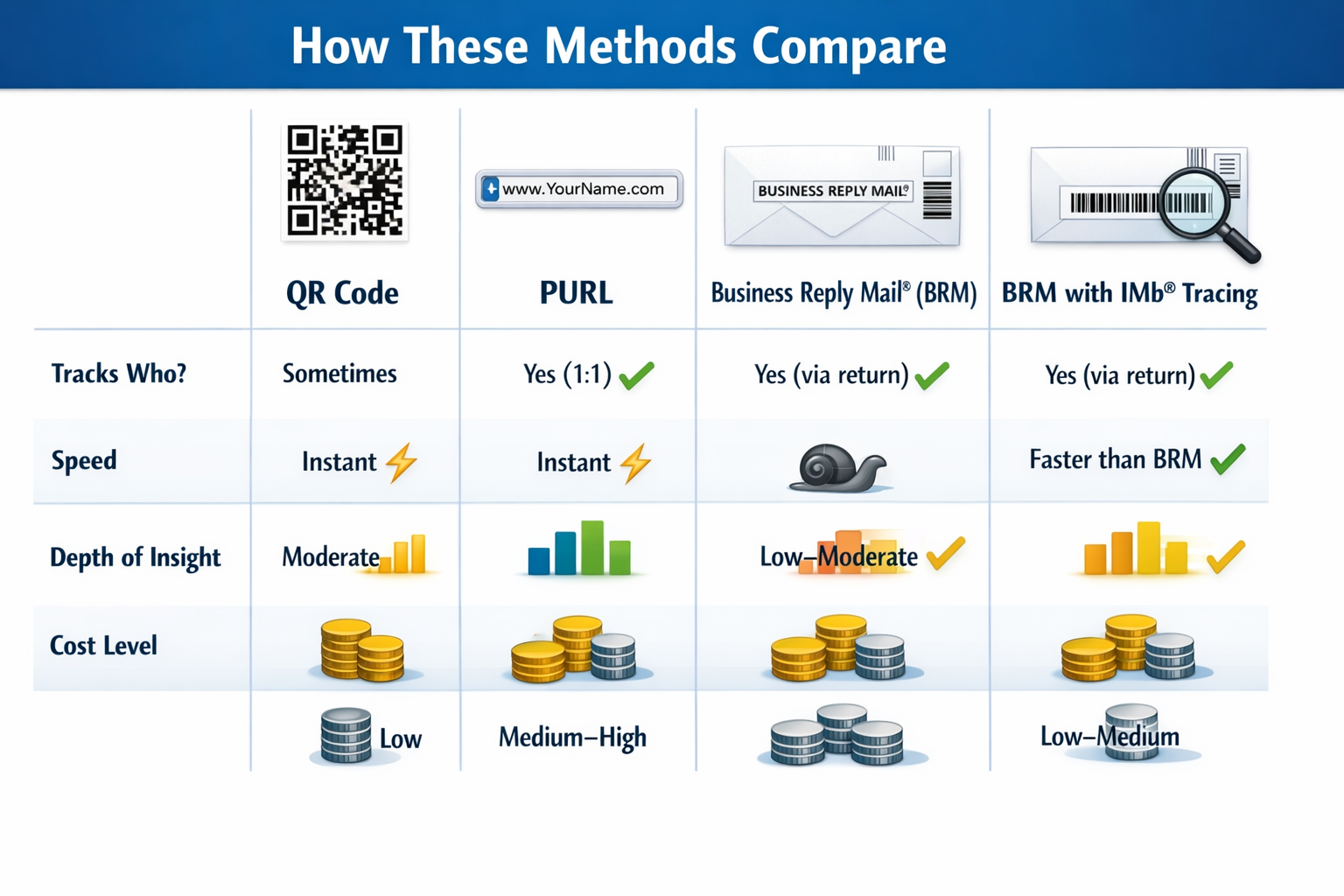
The Bigger Picture: Why It Is Not About Choosing Just One
Each of these methods answers a different question:
-
QR Codes show whether someone engaged quickly.
-
PURLs show who engaged and what they did next.
-
Business Reply Mail® shows who took action.
-
IMb® tracing shows when responses are happening.
When used together, they create a more complete picture of performance, from initial interaction to final conversion.
Final Takeaway
Direct mail is no longer a black box.
With the right tracking strategy, you can move beyond assumptions and start measuring real engagement, real response, and real impact.
.jpg?width=352&name=mailbox_image-_color%20(1).jpg)

.jpg?width=352&name=GreenDMBlogPhoto%20(1).jpg)