
Streamworks Blog
%20(1).png?width=1536&height=864&name=download%20(1)%20(1).png)
There's a quiet pattern in the most effective marketing programs we run.
When the moment really matters, direct mail still leads.
Not because digital is broken. Digital is essential. But there are specific moments (emotional, financial, regulatory, relational) where a screen just doesn't carry the weight a printed piece does.
If you've been reading our content recently, you probably already suspect this. This guide makes the case plainly. When does direct mail actually beat digital? When doesn't it? And how do the best programs combine both to outperform either one alone?
Does direct mail still work in 2026?
Direct mail marketing is noted for its physical, tactile nature, offering a more impactful experience compared to digital ads that are electronic and intangible. As a tangible reminder, direct mail stays in the recipient’s environment, acting as a physical cue that keeps your organization top of mind and encourages ongoing recognition and response. Direct mail has a high engagement rate, remaining in a physical space for an average of 17 days, while digital ads have fleeting visibility.
Direct mail consists of tangible items like postcards, catalogs, and brochures delivered via postal services, while digital marketing includes online channels such as social media, email, and search engine ads. Studies show that 70% of people feel direct mail is more personal than email, and 55% look forward to receiving physical mail. Younger generations often find direct mail more trustworthy and personal than digital marketing, but marketers still need to manage cadence carefully to avoid direct mail fatigue. Direct mail is often recommended to cut through inbox noise and build trust, especially when targeting specific geographic or demographic segments. In B2B marketing, direct mail is more likely to reach busy executives than digital marketing, which may be blocked by filters.
The three moments where direct mail outperforms digital
Most marketers don’t need a lecture on why direct mail works. They need a clearer answer to when to use it.
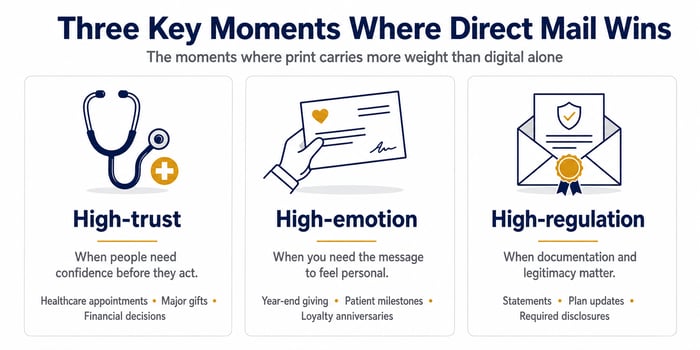
Three moments where mail consistently outperforms digital alone.
The high-trust moment.
When someone has to believe you before they act, a healthcare appointment, a financial decision, a major gift, tangibility matters. A real piece of paper with a real name and a real phone number costs you something to send, and that cost reads as commitment, even subconsciously. Mail signals investment in a way no banner ad can.
The high-emotion moment.
Year-end giving. A patient milestone. A loyalty anniversary. The moments where you want the recipient to feel something. Print does this better than a feed full of competing distractions. Brand recall lands up to 70% higher with print than with digital ads. The science is on mail’s side here. Selecting the right direct mail format—whether postcard, letter, or brochure—ensures your message resonates with the audience and matches the emotional tone of the campaign.
The high-regulation moment.
Statements, plan updates, required disclosures, EOBs (explanations of benefits). Compliance communications aren’t a marketing channel. They’re a trust contract. Mail still wins for documentation, deliverability, and legal weight. We cover this side in detail on our compliance communications services page.
Direct mail also allows precise targeting by neighborhood, zip code, or household characteristics, making it especially effective for local retailers or services.
Direct mail response rates vs email response rates: the real numbers
The numbers people quote are real. The reason behind them is simpler than the stat suggests.
The response rate gap exists for one core reason: the mailbox is less crowded than the inbox.
The average person gets a handful of physical pieces a day and dozens, sometimes hundreds, of digital messages. Less competition means more attention. More attention means more action.
That doesn’t mean direct mail beats digital across the board. It doesn’t.
For low-intent awareness, digital is faster and cheaper. For frequent, time-sensitive nudges, email is hard to beat. For closing warm, retargeted audiences, mail consistently wins. The smart move isn’t picking sides. It’s knowing which moment calls for which channel.
Direct mail vs digital marketing: a side-by-side comparison
Here’s the cleanest comparison we use with clients to evaluate the two strategies: direct mail and digital marketing.
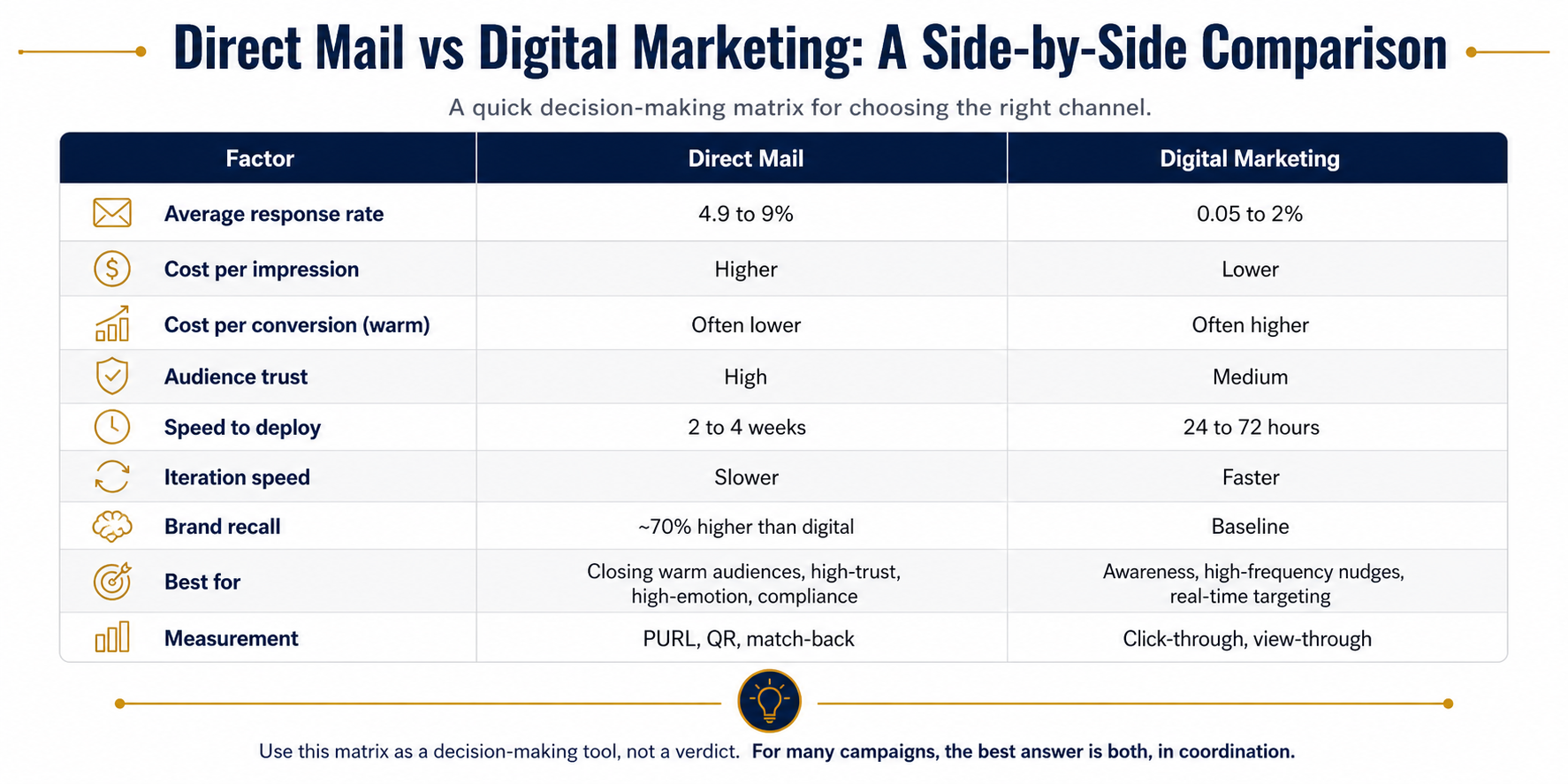
Use this matrix as a decision-making tool, not a verdict. The right answer for any campaign is usually “both, in coordination.” Direct mail targeting is traditionally based on demographic and geographic data, while digital marketing allows for hyper-personalization based on browsing behavior and intent.
When digital beats direct mail (the honest answer)
We'd be hypocrites to pretend mail is always the answer. It isn't.
Digital wins when:
The audience is cold and unqualified.
Awareness campaigns belong on digital. Mail is too expensive per impression to make sense for top-of-funnel awareness against a broad audience.
The timing is hours, not days.
Flash sales, event reminders, abandoned cart in the next 60 minutes. Mail can't compete with email and push notifications on speed.
The budget is small and the audience is large.
Digital scales down. Mail has fixed setup costs that don't make sense at small audience sizes for low-stakes use cases.
You need to iterate creative weekly.
Mail's iteration cycle is measured in weeks. Digital is measured in days or hours. For rapid testing, digital wins.
The honest framing: mail and digital have different jobs. The smart programs use both, deployed against the moments where each one wins.
How direct mail and digital marketing work together
The single biggest mistake most marketers make: running mail and digital as separate programs.
When integrated, the lift is significant. Digital integration—combining personalized messaging with data-driven insights and automation—streamlines processes, improves targeting, and enables timely, relevant communication.
Combining direct mail with digital marketing strategies can increase response rates by approximately 30%, making the integrated approach significantly more effective than using either channel alone. This results in high response rates and greater campaign effectiveness. Combining direct mail with digital marketing can lift overall ROI by roughly 12%. 91% of marketers say integrating the two improves results. Cost-per-conversion can drop below digital-only on warm audiences. Research shows that combining email with direct mail leads to purchases six times larger than email alone.
The integration play we run for clients looks like this.
A digital signal triggers a mail piece. The mail piece arrives. Paid social and CTV ads echo the mail piece for 7 to 10 days after delivery. Email reinforces with the same imagery and offer. The mail and the screen connect and confirm each other instead of competing. Using QR codes in direct mail allows for a direct bridge to digital experiences, enabling recipients to access online resources or promotions easily, and newer tools like augmented reality and NFC are pushing direct mail goes digital technologies even further. Measurement in digital marketing is real-time and granular, while direct mail relies on indirect tracking methods like QR codes.
This is the foundation of what we call the omnichannel approach, and it’s covered in detail in our omnichannel marketing breakdown. Leveraging social platforms and digital channels amplifies the impact of direct mail campaigns, creating a seamless experience across physical and digital touchpoints. Marketers often use direct mail to establish initial trust, followed by digital retargeting to drive conversions. It’s also the model behind the donor journey rethink we wrote about recently.
Direct mail for healthcare, fundraising, and compliance
Three industries where mail’s role is most defined, and where specialized nonprofit and fundraising marketing services can make integration with digital far more efficient.
Healthcare.
Service-line acquisition (orthopedics, cardiology, women’s health), patient reactivation, screening reminders, plan member communications. Mail wins because healthcare lives on trust, and trust lives on tangibility. Personalized messaging in direct mail campaigns for healthcare providers must adhere to HIPAA regulations, ensuring patient privacy and not disclosing sensitive medical details. Healthcare providers often send direct mail to patients as part of their outreach strategy, using automation and data integration to improve engagement. Crafting the right message for postcards and direct mail is essential to engage patients and promote services effectively. Postcards are a cost effective marketing tool for reminders and seasonal notices, offering a simple and affordable way to reach patients quickly. We’ve written specifically about why personalization in healthcare matters.
Fundraising.
Year-end appeals, lapsed donor reactivation, mid-level cultivation, capital campaigns. Mail wins because fundraising lives on emotion, and emotion lands harder in print. Personalization of fundraising appeals can lead to a 5-15% increase in revenue, with adding a person’s name increasing response rates by up to 500%. Direct mail fundraising appeals are more effective when they include storytelling elements that resonate with the donor, emphasizing relevance and respect. The process of organizing, designing, and executing nonprofit direct mail fundraising campaigns is crucial for streamlining tasks and maximizing impact. The organization plays a central role in strategic planning and management of these campaigns, ensuring that efforts are aligned with fundraising goals. Building donor relationships through strategic communication and targeted campaigns helps nurture long-term connections and improve fundraising outcomes. Launching a direct mail marketing campaign allows nonprofits to promote services or fundraising initiatives directly to supporters’ homes. Analyzing different appeal versions is key to identifying what leads to fundraising success and improving future efforts. The importance of raising money for nonprofits through direct mail campaigns cannot be overstated, as this traditional approach remains highly effective. Acquiring new donors through targeted direct mail campaigns expands the organization’s supporter base and grows its donor list. Full service nonprofit marketing integrates multiple channels and tailored strategies to meet diverse fundraising and communication goals. Agencies like Meyer Partners exemplify the expertise and comprehensive services of a full-service nonprofit marketing agency specializing in direct mail fundraising. Direct mail campaigns generate purchases five times larger than email campaigns, highlighting their effectiveness in driving sales. For campaign planning ideas, see how we support nonprofit organizations with integrated fundraising. For format examples, see our fundraising program formats library.
Compliance and member communications.
Statements, plan updates, EOBs, required disclosures. Mail wins because compliance requires accuracy, accountability, and legal weight. Email and digital can’t carry the same compliance posture. Partners like our secure financial communications company and our own compliance communications services handle the full stack.
For all three industries, the right mail strategy is segmented, personalized, and integrated with digital. Consistent messaging across channels is crucial for engaging donors and supporters. None of these wins as a standalone channel. All three win as a closing layer on top of digital. For additional resources on nonprofit marketing and fundraising, explore our guides and tools to enhance your campaigns.
Where direct mail quietly outperforms in 2026
Beyond the three industry buckets, here are the specific use cases where we see mail consistently winning right now, especially when backed by a direct mail partner focused on compliance and fundraising. Direct mail often generates higher engagement rates and has a higher potential ROI than digital marketing, especially in saturated markets.
Donor acquisition for the right files.
Smart list strategy and modeling can make acquisition mail more efficient than ever, particularly when paired with digital reinforcement. Our donor segmentation guide walks through how the data side of this works. For example, a nonprofit used targeted direct mail pieces with compelling calls to action and branding, sent via the postal service, to acquire new donors and saw a significant lift in response rates compared to digital-only campaigns. Direct mail helps businesses engage customers and stay top of mind, as receiving direct mail at home increases the likelihood of engagement.
Lapsed reactivation across industries.
Whether it’s a donor who hasn’t given in 18 months, a patient who hasn’t been in for two years, or a customer who hasn’t ordered in a year, a personalized piece outperforms an email reactivation series almost every time. Direct mail drives customer actions and purchases by delivering tangible reminders that prompt recipients to act. Targeting and engaging patients or customers through receiving direct mail is crucial for reactivating lapsed segments, as it leverages data analytics to identify receptive audiences and integrates with digital touchpoints for greater impact.
Major moments.
Capital campaigns, service-line launches, anniversary gifts. Anything where the brand wants to feel weightier than a feed post. Organizations create compelling content and integrated campaigns across channels to maximize the impact of these major moments.
Account-based marketing for B2B.
A personalized dimensional mailer to a named decision-maker consistently lifts meeting rates compared to email-only outreach. Businesses use direct mailers to reach key decision-makers, integrating direct mail with digital strategies for a complementary approach. Higher cost per piece, lower cost per qualified meeting.
CTV-reinforced campaigns.
Mail dropped 7 to 10 days before a CTV flight, or vice versa, lifts both channels. We covered the CTV side of this here.
When designing campaign materials, it’s important to create direct mail pieces with the right style, size, branding, and call to action to maximize their impact and ensure they stand out to customers. Using the postal service to deliver promotional materials like coupons and flyers directly to customers' homes ensures your message is seen and remembered.
The honest tradeoffs
We’d be hypocrites to pretend mail is always the answer.
It’s slower to deploy than digital. The unit cost is higher. Iterating creative takes longer.
However, direct mail remains effective in 2025, maintaining its relevance as part of an integrated marketing strategy despite the rise of digital marketing trends. But here’s the part that gets missed. When you run mail correctly, with clean data, smart segmentation, real personalization, and integrated digital, the cost-per-conversion can be lower than digital alone, especially on warm audiences. The effectiveness of coordinated strategies—leveraging both direct mail and digital channels—depends on measuring success and performance to maximize impact. Combining mail with digital can lift overall ROI by roughly 12%, and 91% of marketers say integrating the two improves results.
That’s the math worth running. Not what’s cheapest to send, but what’s cheapest to convert.
How to use mail without overspending
Three principles keep direct mail efficient inside an integrated program.
Lead with data, not creative.
A great piece sent to the wrong list loses. A decent piece sent to the right list wins. The data side is more important than the design side, every time. We’ve written about where data modeling stands in 2026 and continue to share tactics on the Streamworks marketing blog. Data analytics tools can help organizations track engagement patterns and demographics, allowing for targeted direct mail campaigns that resonate with specific audiences. Streamlining the process of organizing, designing, and executing direct mail campaigns can significantly improve efficiency and simplify complex tasks.
Pair it with digital every time.
Mail in isolation underperforms mail wrapped in coordinated email, social, and CTV. Don’t run mail alone if you can integrate.
Measure honestly.
PURLs, QR codes, match-back analysis, clean attribution windows. We unpack all of this in the direct mail engagement tracking guide. Setting specific goals and measuring the impact of direct mail campaigns is essential for assessing progress and optimizing future fundraising efforts.
How to measure direct mail ROI
The same three methods that work for personalized retargeting mail apply here.
Match-back analysis.
Compare your mail recipient list against your CRM conversion list. Most programs find 30 to 50% of attributed conversions came from mail.
Holdout testing.
Hold out a control group. Compare conversion rate, average gift, or average order value at 60 to 90 days. The difference is your true lift.
PURL and QR scanning.
Direct attribution through unique URLs or QR codes. Underestimates total impact but gives you a clean directional signal.
The best measurement combines all three. Insights gained from campaign performance evaluation and analytics can then be used to inform future targeting strategies and creative design, optimizing the effectiveness of subsequent campaigns.
The bottom line
Digital and direct mail aren't rivals. They're partners with different jobs, which is why many organizations lean on a direct response and compliance communications partner to orchestrate both.
Digital finds. Mail closes.
Together, they cover the moments single-channel programs miss. And in 2026, with digital costs rising and the mailbox quieter than ever, the case for integrated programs is stronger than it's been in a decade.
If you've been rethinking your channel mix for a year-end campaign, a service-line push, or a compliance program, that's exactly the kind of conversation our team has every day. For nonprofits, our fundraising program services build mail and digital into a single integrated layer. For regulated industries, our compliance communications services handle the full mail-required stack, supported by a broader direct response and compliance communications practice.
Let's map the right mix for your next moment →

Frequently asked questions about direct mail vs digital
Is direct mail still effective?
Yes. Direct mail response rates have stayed strong even as digital costs have risen. For warm audiences, high-trust moments, and high-emotion moments, mail consistently outperforms digital-only programs. The mailbox is less crowded than the inbox, and that gap is widening.
What's the average response rate for direct mail?
House lists average around 9%. Prospect lists average around 4.9%. Personalized retargeting mail (triggered off website behavior) often outperforms both because the audience is already qualified.
How does direct mail compare to email and digital ads?
Email averages around 0.6% response. Display ads average 0.05 to 0.1%. Direct mail averages 4.9 to 9% depending on list type. Digital wins on cost-per-impression and speed. Mail wins on response rate and audience trust.
When should you use direct mail vs digital marketing?
Use direct mail for high-trust moments (healthcare, finance, major gifts), high-emotion moments (year-end giving, loyalty milestones), high-regulation moments (statements, compliance), and warm closing on retargeted audiences. Use digital for awareness, time-sensitive nudges, rapid creative iteration, and large-volume low-stakes communication.
How much does direct mail cost per piece?
Most B2B, healthcare, and nonprofit programs land between $0.75 and $2.50 per piece all-in (data, creative, printing, postage). Personalized retargeting mail tends to land at the higher end of that range but consistently delivers a lower cost-per-conversion than digital-only on warm audiences.
Does direct mail work for nonprofits?
Yes, particularly for lapsed reactivation, mid-level cultivation, and year-end appeals. Donor audiences respond strongly to personalized mail with real photography and a personal touch, and the integration with digital lifts overall fundraising ROI significantly.
Does direct mail work for healthcare marketing?
Yes. Mail consistently outperforms digital-only programs for service-line acquisition, patient reactivation, and screening reminders. Healthcare's trust requirement makes the tangibility of print especially valuable.
Can you integrate direct mail with digital marketing? If you’re looking for ongoing ideas and examples, our Streamworks blog on direct mail and digital marketing covers this in depth.
Yes, and you should. Integrated programs lift overall ROI by roughly 12%, and 91% of marketers report integration improves results. The play: trigger mail off digital signals, reinforce with email and CTV after delivery, measure with match-back and holdout testing.
.jpg?width=352&name=GreenDMBlogPhoto%20(1).jpg)

.jpg?width=352&name=Hero-Blog-Pic%20(1).jpg)