
Streamworks Blog
.jpg?width=300&height=175&name=image-(2).jpg)
You spent months getting them to click. A donor researching where to give before year-end. A hospital marketing director comparing patient outreach vendors. A development director sizing up a new acquisition partner.
They land on your site, scroll a couple of pages, maybe even start a form, and then they’re gone. Website retargeting is highly effective because 96% of visitors leave a website without buying anything on their first visit.
So what actually happens next?
Honestly, on most sites, nothing.
That’s the problem website retargeting is built to fix. Retargeting ad campaigns are designed to re-engage those visitors by showing them tailored ads across platforms like Google Ads and Facebook. Website retargeting helps nonprofits keep their mission visible and compelling to supporters, encouraging ongoing engagement. A well-planned retargeting strategy is essential for re-engaging visitors who have already shown interest in your organization, with studies showing up to 70% of consumers are more likely to convert after seeing a retargeted ad.
This guide walks through what website retargeting actually is, why your traffic isn’t converting the way you think it should, what good retargeting looks like across digital and direct mail, and how planning and optimizing a retargeting campaign is a key part of bringing back visitors that everyone else writes off.
Why 98% of website visitors don't convert
On most B2B and nonprofit sites, only about 2% of first-time visitors convert. The other 98% leave.
Read that again. 98%.
That isn’t a website problem. It’s human behavior. People get pulled into meetings. Kids ask for snacks. Phones buzz. The intent was real. The timing wasn’t.
Without a follow-up plan, all the traffic you paid for through paid search, paid social, email, and SEO walks out the door. Most of that traffic isn’t gone. It’s paused.
The brands and nonprofits getting the most out of their digital spend in 2026 are the ones who treat that 98% as a list to follow up on, not a list to forget.
That’s what retargeting is for. For nonprofits, retargeting is a cost effective way to re-engage supporters and maximize the nonprofit's budget. By focusing ad spend on warm leads—such as previous supporters—rather than cold outreach, organizations see a higher ROI and make the most of every marketing dollar, especially when paired with targeted direct mail and integrated nonprofit marketing strategies.
What is website retargeting (and what it isn't)
Website retargeting is a marketing tactic that uses digital ads to re-engage users who have already visited your website, delivering follow-up messages across other channels.
The core mechanic is simple. A small piece of code on your site (a pixel, a tag, or a server-side equivalent) quietly notes when someone visits. Retargeting ads work by tracking these users—especially those who have previously visited but did not complete a desired action, such as making a donation or signing up—so that later, that same person can see your message on social, on news sites, on streaming TV, and depending on your data setup, in their physical mailbox.
It’s not stalking. It’s continuity.
A few things retargeting is not.
It’s not the same as remarketing, although the terms get used interchangeably. Technically, remarketing tends to refer to email-based follow-up while retargeting tends to refer to ad-based follow-up. Most modern programs blend both, so the distinction matters less every year.
It’s not just display ads. The most effective retargeting today runs across paid social, CTV, email, push notifications, and direct mail. Retargeting ads can be run on various platforms including Google Ads, Facebook, Instagram, YouTube, LinkedIn, and Bing, each offering unique features and audience targeting capabilities. We’ll come back to that.
It’s not a shortcut for fixing a broken funnel. If your form is confusing or your value prop is unclear, retargeting will just spend more budget bouncing the same people around. Fix the funnel first. Then turn on retargeting.
How retargeting actually works (the simple version)
Three things have to happen.
You identify the visitor.
A pixel or tag fires when someone lands on your site. Advertising platforms use cookies to build audience lists and track user behavior, such as which specific product or donation pages they viewed. For known visitors (people who are logged in, have clicked an email, or have given you their info), you can match them to a record. For anonymous visitors, you can match them to a device ID, an IP, or a household using identity resolution providers. Dynamic retargeting can automatically update ad creative to show products or causes a user specifically viewed.
You segment them by intent.
Not every visitor deserves the same follow-up. Nonprofits can create audience segments or groups based on user behavior and interest. For example, a blog reader who spent 90 seconds on a thought-leadership post is at a different stage than someone who hit your pricing page or started a giving form. Segmenting your audience allows for tailored messaging and improved engagement, as different groups may respond to different appeals based on their interests and behaviors. Effective audience segmentation leads to higher conversion rates by focusing on individuals who have already showed interest or previously interacted with your cause.
You reach them somewhere else.
That’s the actual retargeting moment. Display, paid social, CTV, email, and direct mail are the most common channels in 2026. The best programs run two or three of these in coordination, not just one, often integrating digital tactics like email, IP targeting, and postal remarketing with traditional channels.
What good website retargeting looks like in 2026
A lot of brands stop at the basics. A generic display ad chasing people around the internet. That’s table-stakes and frankly a little annoying.
Smart retargeting today does four things differently.
It’s segmented.
A pricing-page visitor never sees the same ad as a blog reader. A donor who clicked the $1,000 giving option doesn’t see the same creative as someone who downloaded a free guide. Focusing on your warm audience—people who have already interacted with your site—is an effective way to increase engagement and conversions. Most retargeting programs lift performance by 20% or more just by adding two or three real segments.
It’s multi-channel by design.
Display, paid social, CTV, email, and direct mail working together instead of in silos. The mailbox in particular is where most B2B and nonprofit retargeting is leaving money on the table. We dig into that in our omnichannel marketing breakdown and share more examples on the Streamworks blog about direct mail and integrated marketing trends.
It’s frequency-capped.
A retargeting ad seen four times in a day is helpful. The same ad seen 40 times in a week is the marketing equivalent of a stalker. Cap your frequency. Rotate creative. Respect the audience. To maximize engagement and reach your full potential, nonprofits should refresh their ad creative every 60–90 days to keep content fresh and reduce audience fatigue. Using urgency and scarcity tactics, such as countdown timers, can also prompt faster action from supporters.
It’s measured beyond the click.
Click-through and view-through are useful but incomplete. The average click-through rate for retargeted ads is roughly ten times higher than traditional display ads, making them a highly effective tool for engaging potential supporters. The best programs use match-back analysis to catch the offline signals digital can’t see. We’ve written a full guide to measuring direct mail and integrated engagement that covers this in depth.
A real-world scenario: how multi-channel retargeting closes the loop
Here’s how this plays out for a real organization.
A supporter visits a nonprofit’s donation page on November 8. She clicks the $100 option, begins to donate, but abandons the donation before completing the form—becoming one of many abandoned donations and a potential donor who has shown interest but not yet contributed.
Without retargeting campaigns, the nonprofit hopes she comes back. Most of the time, she doesn’t, and the opportunity to engage donors, re-engage past supporters, or acquire new donors is lost.
With retargeting:
Three days later, a 15-second video shows up in her Instagram feed featuring the program her gift would support. She watches 12 seconds.
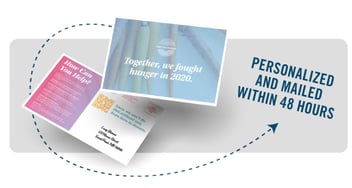
The next week, a personalized postcard hits her mailbox with the same imagery, the same story, and a QR code that drops her right back on the donation page, prefilled with the $100 amount.
She lets it sit on the kitchen counter for a day. She picks it up twice. She scans the QR code on the third pass.
By December 12, she gives $250 instead of $100, because she finally felt the story instead of just seeing a form.
Retargeting campaigns like this are designed to re-engage potential donors, recover abandoned donations, and encourage people to donate—helping nonprofits engage donors, re-engage past supporters, acquire new donors, and strengthen support for their cause and community.
That’s retargeting working as a system, not a tactic. And it’s the same play we see working for donor journeys across the year.
Why direct mail retargeting outperforms in healthcare and nonprofit
The mailbox is one of the least crowded channels left.
The average inbox gets 100+ emails a day. The average mailbox gets a handful of pieces. That alone is a competitive advantage.
For healthcare audiences (where trust matters) and fundraising audiences (where emotion matters), direct mail retargeting is a cost-effective approach that can dramatically lift response. The mechanic is simple. Match a website visit to a postal address using identity resolution. Drop a personalized piece. Your abandoned visitor suddenly has a tactile reason to come back.
A few specifics on why mail wins for these audiences.
Healthcare lives on trust.
A printed piece with a specific provider, a real phone number, and a local address signals legitimacy in a way a banner ad simply can’t. For service-line acquisition (orthopedics, cardiology, women’s health), personalized mail consistently lifts appointment requests when paired with a digital footprint. We unpack the patient personalization play in detail in Personalization in Healthcare and show how tools like USPS Informed Delivery can extend fundraising direct mail with digital previews.
Fundraising lives on emotion.
The story you can tell in a folded self-mailer with a real photograph hits a different part of the brain than a 6-second pre-roll. For year-end appeals, mid-level cultivation, and lapsed donor reactivation, personalized mail keeps outperforming digital-only programs, especially when both run together. Choosing the right platform—integrating direct mail with digital advertising—can expand a nonprofit's reach, allowing you to connect with both existing supporters and potential donors. Digital advertising, when combined with direct mail, maximizes engagement and impact across channels.
Retargeted ads see click-through rates roughly 10 times higher than standard display, and most marketers report that retargeting outperforms cold email and cold search for re-engaging warm traffic.
.jpg?width=644&height=376&name=Untitled-2%20(1).jpg)
CTV: the retargeting channel most B2B and nonprofit teams underuse
Connected TV is the third leg of a real retargeting program in 2026, and most teams haven’t turned it on yet.
The play is simple. Someone who has previously interacted with your organization—such as visiting your website on a laptop—triggers a sync to a household identifier. That night, while they’re streaming Hulu or Roku, or even browsing other sites and platforms, they see a 15- or 30-second spot for your organization. The moment is unexpected, the format is high-impact, and the cost-per-impression has come way down. We covered the full case for CTV in nonprofit marketing here
CTV retargeting is also effective for event marketing. For example, you can serve personalized ads to event attendees, encouraging them to revisit event pages or complete their registration.
For healthcare service-line marketing, CTV retargeting is especially strong because households are the natural buying unit for most health decisions.
How to measure website retargeting beyond the click
If you only measure click-through rate, you’re missing most of the story. Using positive and mission-focused messaging in your website retargeting ads is also crucial, as it helps keep your mission visible and compelling to supporters while ensuring potential donors feel comfortable and not overwhelmed by the ad experience.
A real measurement stack looks like this, and it depends on having accurate supporter data—something you can strengthen by appending missing customer contact information.
Click-through and view-through conversions.
The basic digital baseline. Useful but not the whole picture.
Match-back analysis.
Compare the list of people who converted to the list of people you retargeted. Even if they didn’t click, did they convert? Most programs find that 30 to 50% of attributed conversions came from people who saw the ad but didn’t click.
Holdout testing.
Hold out a control group from your retargeting audience. After 60 to 90 days, compare conversion rate, average gift, or average order value between the holdout and the retargeted group. This is the cleanest read on actual lift.
Multi-touch attribution.
Don’t give last-click all the credit. The best programs assign weight to every touchpoint, including the mail piece, the CTV impression, and the email.
If your current measurement stack stops at click-through, you’re underinvesting in retargeting and you don’t know it.
Common retargeting mistakes (and how to avoid them)
A few patterns we see all the time.
Treating all visitors the same.
A homepage visitor and a pricing page visitor are not the same audience. Don’t show them the same ad.
Running mail in isolation.
Mail without digital reinforcement underperforms mail wrapped in coordinated email, social, and CTV. Don’t run mail alone if you can run it integrated with a direct response and compliance communications partner like Streamworks.
Stopping the retargeting window too early.
B2B sales cycles are often 60 to 180 days. Year-end giving cycles run six weeks. Healthcare appointment decisions take 30 to 90 days. Don’t cap your retargeting window at 14 days because that’s the default.
Ignoring suppression.
Once someone converts, suppress them. Few things annoy a donor more than seeing the same “give now” ad after they’ve already given. Set up conversion suppression on day one.
Measuring only what’s easy to measure.
Click-through is easy. Real lift is harder. The teams that win are the ones who do the harder measurement work and stay current on direct mail and digital marketing best practices from the Streamworks blog.
Not learning from for profit companies.
For profit companies have long used retargeting to increase sales and engagement. Nonprofits can benefit from adopting similar website retargeting strategies to re-engage supporters and drive conversions, and resources like the Streamworks nonprofit marketing articles by Lindsay Valenty can help bridge that gap.
The bottom line
Most of your website traffic isn’t lost. It’s paused.
The brands and nonprofits getting the most out of their digital spend in 2026 are the ones building thoughtful, multi-channel follow-up campaigns around the people who already raised a hand.
Retargeting isn’t just a tactic. It’s a system—and when you run ongoing retargeting campaigns using tools like Google Ads, you can build awareness and engage supporters over time. Done right, it’s the highest-ROI lever in your marketing stack.
If you’re rethinking your retargeting program, especially the integration of direct mail and digital, that’s exactly the kind of work our team does every day at Streamworks. For nonprofits, our fundraising program services include built-in retargeting layers across digital and mail, supported by broader nonprofit and fundraising marketing services.
Curious what the right mix could look like for your audience? Let’s talk through your traffic → or explore how a direct response and multi-channel communications partner can support your program.
Frequently asked questions about website retargeting
Is website retargeting the same as remarketing?
The terms are used interchangeably, but technically remarketing usually refers to email-based follow-up, while retargeting usually refers to ad-based follow-up across display, social, CTV, and increasingly direct mail. Most modern programs blend both.
How much does direct mail retargeting cost?
Cost varies based on volume, format, and personalization, but most B2B and nonprofit programs land between $0.75 and $2.50 per piece all-in (printing, postage, data, and creative). On warm retargeting audiences, the cost-per-conversion is often lower than digital-only because the audience is already qualified.
How long should a retargeting window be?
It depends on your sales or giving cycle. For B2B, 60 to 180 days is typical. For year-end giving, six to eight weeks. For healthcare appointment booking, 30 to 90 days. Don’t default to 14 days unless your audience converts that fast.
Does retargeting work for nonprofits?
Yes, and especially well when paired with personalized direct mail. Nonprofits often see better retargeting ROI than B2B because donor audiences are more emotionally engaged and respond strongly to story-led creative across multiple channels. Retargeting can also be used to encourage users to sign up for events, volunteering, or donations, making it a powerful tool for driving engagement.
Can I retarget anonymous website visitors with direct mail?
Yes, through identity resolution. Modern providers can match a percentage of anonymous website visitors to postal addresses, allowing you to drop a personalized piece even when the visitor never gave you their information directly. Match rates vary, but 30 to 50% of US-based anonymous traffic is achievable on most B2C, healthcare, and nonprofit audiences.
How do I measure retargeting ROI?
Use a combination of click-through and view-through conversions, match-back analysis, and holdout testing. The cleanest measurement is a holdout group: compare the conversion rate of retargeted users against a held-out control group of similar visitors. The difference is your true lift. Retargeting strategies can also segment audiences into groups, such as donors, volunteers, or event participants, allowing for more tailored messaging and improved re-engagement of supporters like volunteers.

%20(1).png?width=352&name=download%20(1)%20(1).png)
.jpg?width=352&name=770X310-Fundraising-V2%20(1).jpg)